Your child’s class teacher: If you have any concerns or queries about your child/ren, whether they do have or may have Special Educational Needs or not, you should contact your child’s class teacher.
Our SENCO is Mr Jones, who can be contacted via the school office. The role of the SENCo involves ensuring that:
The Academy Councillor for SEND can be contacted via the school office. The Academy Councillor for SEND is able to support and challenge the effectiveness of the SEND policy as it is in school.
Our Pastoral and Safeguarding Lead(s) are TBC and Mr Jones. TBC will be about to support families with a range of parenting and pastoral needs.
School address: Airfield Primary Academy, 23 Norman Place, Weston-super-Mare, BS24 8GH
Telephone: TBC
SEND stands for Special Educational Needs & Disabilities and is underpinned by the contents of the SEND Code of Practice, 2015.
The Code of Practice states that ‘A child or young person has SEN if they have a learning difficulty or disability which calls for special educational provision to be made for him or her.’
A child of compulsory school age or a young person has a learning difficulty or disability if he or she:
There are lots of ways to help children to thrive in this school.
| High-quality teaching | ||||
| Strong relationships | Ready to learn | Planning for needs | Explicit instruction | Talk to learn |
| Teachers develop positive trusting relationships with children and families. | Pupils’ needs are met and expectations are high on behaviour.
A calm and predictable environment will help all children
|
All pupils should be able to excel, and teachers rigorously assess and plan to meet the needs of learners. | Clear modelling and structured lessons.
Information will be explained ‘in chunks’, with time to pause and process information.
|
Techniques within lessons ensure pupils are highly engaged and these techniques support the development of oracy and assessment for learning. |
In addition to the above, your child may benefit from approaches described below, although not limited to:
We aim to meet the needs of all pupils and recognise the four broad areas of need, as set out in the SEND Code of Practice (2015):
| Communication and Interaction (C&I) | Cognition and Learning (C&L) | Social, Emotional, Mental Health Needs (SEMH) | Sensory and /or Physical needs (S/P) |
| Speech, language and communication needs (SLCN)
Autism Spectrum Disorder / Condition (ASD / ASC) |
Moderate learning difficulties (MLD)
Severe learning difficulties (SLD) Profound and multiple learning difficulties (PMLD) Specific learning difficulties (SpLD) |
Attention deficit disorder (ADD)
Attention deficit hyperactivity disorder (ADHD) Attachment disorder |
Hearing impairment (HI) Multi-sensory impairment (MSI)
Visual impairment (VI) Physical disability (PD) |
| Needs within the four broad areas of need can include: | |||
C&I:
|
C&L
|
SEMH
|
S/P
|
We believe in stages of provision to enable all children to access high quality teaching and where needed have personalised strategies and specialist/highly tailored and bespoke teaching and learning.
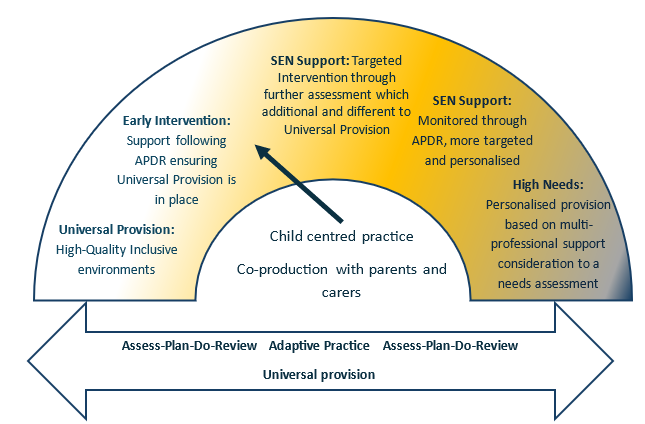
We support every child through a step‑by‑step approach that starts with high‑quality teaching in the classroom. Teachers adapt lessons so that most children’s needs can be met without extra support.
If a child is still not making the progress we expect, we look more closely at what they need. We do this together with parent/carers. This may lead to extra help called SEN Support, which is reviewed regularly to check it is working.
If the child makes good progress, they may no longer need this additional support.
For children with more complex needs, we may need to provide more personalised help. In some cases, we may request an Education, Health and Care (EHC) assessment to see if they require higher‑level support.
If a child is believed to have a Special Educational Need or Disability which hinders their progress within school, the graduated approach will be adopted as below:
Working out your child’s needs and specifically what they need help and support with.
Planning the support provided by school staff and other professionals.
Planned support is given in school. Your child will need enough time to adopt and see if it works.
Regularly discussing whether the support is making a difference and if the plan needs to change.
How we identify children with SEND?
 |
Class teachers Class teachers and the school leadership team regularly check how all children are getting on with their learning and development. These assessments help us to notice if a child may be finding certain things more difficult and whether they might need a little extra support. |
 |
Screening tools We use a range of simple screening and assessment tools to help us understand a child’s strengths and any areas where they may need support. These tools help guide our decisions, but please note that school staff cannot offer medical diagnoses. |
 |
Health professionals When appropriate, health professionals may be involved to help with assessment, diagnosis and ongoing support for children with significant medical needs or disabilities. |
 |
Parents and families Parents and carers know their child best. Children can behave and learn differently at home and at school, so we really value your knowledge, insights, and any concerns you may wish to share. |
 |
Some signs we may notice
|
Most children on the SEND register have an Individual Learning Plan (ILP). These detail small-step targets for children. These are discussed and shared with parents.
Some children might have a Pupil Passport. These ‘passports’ provide a profile your child. These are shared with parents.
Where behavioural needs are identified, an additional support plan may be required. These are shared with parents.
Children with external professionals involved in their support may have specialist programmes and reports. These can be shared with parents.
These are detailed below: |
|
| Term 1 | ILP shared by class teacher
Parents requesting Special School places – Early Review with SENCO X1 SENDco drop-in session |
| Term 2 | Parents’ evening with class teacher
Pupil report card |
| Term 3 | X1 SENDco drop-in session
ILP shared by class teacher |
| Term 4 | Parents’ evening with class teacher
ILP shared by class teacher Pupil report card |
| Term 5 | X1 SENDco drop-in session
ILP shared by class teacher |
| Term 6 | Parents’ evening with class teacher
X1 SENDco drop-in session Pupil report card |
 |
Listening to children’s views (Pupil Voice) At APA, we make listening to children’s views a natural part of everyday school life. Children’s interests and opinions are important and help us keep them motivated and involved in their learning. You may hear your child talk about using ‘Blob Trees’, which are simple visual tools that help children share how they are feeling and what they think. |
 |
Talking with children about their learning Members of our Inclusion Team talk with children who have SEND at least twice a year to hear their views and experiences. School leaders also speak with children, including those with SEND, once each term. These conversations give children the chance to talk about how well they feel supported in class and to let us know what is working well or what might be harder for them. |
 |
Pupil surveys Twice a year, all children take part in a whole‑school survey. They are asked to share their views by responding on a simple numbered scale. The questions cover areas such as their lessons, school activities, feeling safe, and friendships. |
 |
Feedback during learning Teachers give feedback to children as they are learning, rather than only at the end of a task. This allows children to talk openly about what they find easy, what they find tricky, and how they feel about their learning at that moment |
 |
Interacting with children throughout the day
Staff carefully interact and observe children during lessons, playtimes, and other parts of the school day. This helps us understand what children enjoy, what they find difficult, and how best to support them. Children communicate in different ways. For some children, we support them to use the methods that help them share their thoughts and feelings. |
| Joining Nursery & Pre-school | School tour, induction meetings with parents, home visits, family meetings, Stay ‘n’ Play sessions |
| Joining Reception | School tour, Induction meetings with parents, Stay ‘n’ play sessions, social events e.g. family picnic, home visits, SENCo meetings with family/professionals, home visits, graduated 10-day induction in September (part timetable to full timetable). |
| Joining within Key Stage 1 & 2 | School tour, SENCo meetings with family/professionals, home visits, meeting with previous educator, transition afternoons experiencing next year teachers. |
| Joining secondary school/ Key Stage 3 | School tour, secondary, transition days, meetings between school SENCos and teachers from previous and new school. |
| Schools receive funding for all children, including those with Special Educational Needs and Disabilities and funds are used to meet their needs. | The Local Authority may contribute more funding if the cost of meeting an individual child’s additional needs is more than £6,000 a year. | The assess-plan-do-review cycle will inform planning for allocation of staffing and appropriate interventions. |
| We use staffing flexibly across the school, so each class has the level of adult support needed to help children learn well.
|
If your child qualifies for an Education, Health and Care plan (ECHP), the assessment of your child’s needs identifies something that is significantly different from what is usually available, there may be additional funding allocated. | For students who have an EHCP, our focus is that their needs are met and their objectives worked on. This is often better achieved by pooling resources e.g. running interventions for small groups or providing an additional adult across a year group. |
The school offers a wide range of opportunities beyond the classroom, including after‑school clubs, lunchtime activities, school trips, and visits from guest speakers.
At our school, we place great importance on working closely with a range of external professionals and services to ensure children and families receive the right support. We commit significant time and resources to building these strong partnerships.
If a child’s needs require support beyond the expertise available within our school team, we will always aim to involve the most appropriate specialist. This helps us to better understand your child’s needs and put the right support in place.
A variety of services can include:
These partnerships help to provide the best possible guidance and support for your child.
| Airfield Primary Academy is fully accessible and meets the requirements linked to the Equalities Act and the Disability Discriminatory Act. The school has an Accessibility Plan. | The site is accessible to students and parents with physical limitations and/or mobility impairments. | We have disabled parking areas from which, people can enter the school. |
| Rooms at ground level are clear of room thresholds, steps, and are wide enough to allow wheelchair access. To access the first floor, there is a lift. | Disabled toilets and walk in shower/changing areas are available around school. | Our outside spaces are flat and accessed via wide, flat entrances. |
North Somerset’s Local Offer can be found on their SEND Hub website:
https://n-somerset.gov.uk/my-services/children-young-people-families/send-hub-local-offer
This hub has lots of useful information about special educational needs and disabilities (SEND) and explains what support is available in North Somerset.